July 2008
Edited by Tina & Dennis Homes
THE DANGER OF 'XYLITOL'
In the space of just one week I have heard of two separate incidents of dogs being poisoned by eating sugar-free chewing gum. Both cases took place in the United States where the use of xylitol as an artificial sweetener has dramatically increased in recent years. I am uncertain how widespread xylitol is used in the UK, I have checked the ingredients of some of the popular chewing gums and it appears that it’s the non sugar types such as Orbit that contain xylitol. In fact Orbit mention xylitol as a main ingredient in their current run of TV adverts where they are promoting their product as useful in combating plaque and keeping teeth healthy. I know by our emails that these pages are read in a great many countries, so it is wise to investigate locally which products contain xylitol and for everyone to be on their guard. Even if you have gum that does not contain xylitol it is always a wise precaution to keep all foodstuffs out of the reach of your dog.
Xylitol, which is found naturally in very small amounts in both strawberries and raspberries, tastes just like sugar but with far fewer calories. The food industry has been using this non-sugar sweetener in many foods particularly in diabetic preparations, mints, sugar-free puddings and chewing gum. Although it has been deemed safe for human consumption it can be fatal in dogs. Even small amounts can cause mass insulin release in dogs which quickly leads to severe acute hypoglycaemia. The rapid loss of blood sugar levels soon leads to liver failure.
The first case that I heard of was a dachshund who managed to steal just three gums from a handbag. Fortunately the owner had heard that xylitol can be deadly for dogs and acted speedily got the dog straight to the vets. But even then things were touch and go as her blood sugar had dropped from 90 to 59 in just thirty minutes. The vet gave the dog a charcoal drink to induce vomiting and then put her on an IV drip with dextrose. The dog was placed in intensive care for the whole weekend. Had the owner not acted promptly the dog would most certainly have died.
The second case was strikingly similar, but this time was with two cavaliers. A friend had visited the cavalier owner and put her bag on the floor. The minty smell of the gum in the bag soon aroused the attention of the dogs and one of them managed to grab the packet and the two of them began chewing the gum. Fortunately the owner caught them in the act and as she had a veterinary background took immediate action. She induced vomiting by giving them hydrogen peroxide, (not ideal but this was a dire emergency and it probably saved their lives). Again these two dogs spent some time in intensive care.
The stark warning to all dog owners is be very careful with what you leave lying around. Sweet minty things are like magnets to dogs, and as we have mentioned before on these pages there are many food stuffs that are regular parts of the human diet and yet can be highly toxic to dogs. Only give dogs treats that are specifically prepared for them. It is far better to be safe than sorry.
After writing this article I noticed an advert for a product called Vetaquadent, which is added to a dog’s drinking water to help keep their teeth clean and free from plaque and tartar. I was slightly alarmed to read that the product contained xylitol, so I immediately e-mailed one of the main distributor’s, Canine Chemist, (who are a highly reputable company), and voiced my concern. They very promptly e-mailed me back and their reply was reassuring. This is their reply:
“Thank you for your email. Confectionery can be very dangerous to dogs and probably ought to carry a health warning to them. Chewing gum (with its high levels of Xylitol) and chocolate (with xanthines) have both proved fatal. However the Xylitol in Vetaquadent is far below the toxic level. I attach some information that the manufacturers provided last year and which may reassure you”.
“We are of course fully aware of the xylitol issue and yes it is toxic to dogs...but at much higher dose rates than that in Vetaquadent. The toxic dose of xylitol for dogs is in the order of 150mgs/kg bodyweight. At this dose level dogs can suffer a surge in insulin release and then develop hypoglycaemia (low blood sugar). At 500mgs/kg dogs may suffer liver failure or severe liver damage. Basically dogs are at risk of suffering hypoglycaemia following ingestion of chewing gum owing to its high xylitol content. On average a single piece of chewing gum contains 1gram (1000mg) of xylitol so a small dog runs the risk of intoxication after swallowing just one piece of gum! The concentration of xylitol in Vetaquadent is 0.5% = 5mg/ml. Following dilution at the rate of 6ml per 250ml water this equates to a total of 30mgs xylitol. If a 10kg dog drinks all of this 250 ml of treated water this equates to a dose of 3mgs/kg xylitol which is some 50 times below the minimum toxic dose of 150mg/kg. So in other words a 10kg dog would have to drink 12.5 litres (nearly 3 gallons or one and a half buckets) of water treated at the recommended dose rate of Vetaquadent to run any risk of toxicity.”
CAVALIER COLLECTABLES
Back in the January Pet Pages we ran a feature on Cavaliers on postage stamps. This article aroused quite a lot of interest so over the coming months we will feature other Cavalier collectables such as postcards, cigarette cards, figurines, etc. This month it’s ‘Odds and Sods’, in other words odd items they we have come across that feature Cavaliers.
The first items are two cigar wrappers, one with a Blenheim and the other with a Blenheim and a Ruby.
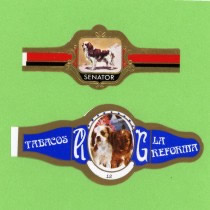
If anyone has details of other cigar wrapper with Cavaliers on I’d love to hear from you.
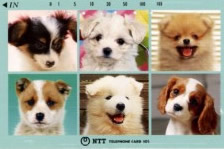
Next up is a phone card. For a short period during the late eighties and early nineties phone cards became extremely popular, but with the rise of the mobile phone they soon disappeared as fast as they came. However, during their brief time of popularity they also became collector’s items and below is one that I uncovered that featured a Cavalier.
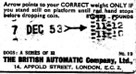
Those of you who are of an age of mature experience like myself, (in other words an oldie !!!), may recall scales in stores such as Woolworths where you would stand on the scale, insert a penny and out would pop a small card with your weight discreetly printed on it. Below is one such card from 1953 which shows the weight on one side and a picture of a King Charles Spaniel on the reverse.

Another interesting find is a business card for a jeweller in Philadelphia. I do not have an accurate date for this but it was probably from the 1920s.

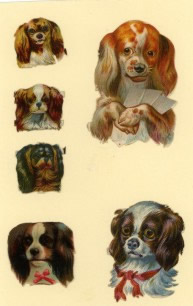
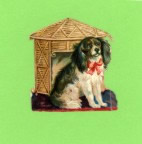
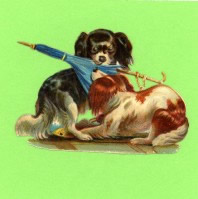
Finally, in the late Victorian and Edwardian times scrapbooks were extremely popular, particularly with the English middle classes. All sorts of keepsakes would be kept in these books and they would be highly embellished with small decorative stickers that were on sale in shops. These would take the form of flowers, butterflies, birds and animals. Below are a number of scraps that I have uncovered that feature Cavaliers.

DID YOU KNOW?
- The oldest known breed is likely the Saluki – originally trained by Egyptians to help them track game.
- An African wolf dog known as the basenji is the only dog in the world that cannot bark.
- Dachshunds were originally bred for fighting badgers.
- The world’s smartest dogs are thought to be (1) the Border Collie (2) the Poodle and (3) the Golden Retriever.
- While the dumbest dog is believed to be the Afghan Hound.
- A dog’s smell is more than 100,000 times stronger than that of a human’s which they need because their eyesight is not as keen as a human’s.
- Dogs judge objects first by their movement, then by their brightness, and lastly by their shape.
- Smaller breeds mature faster than larger breeds.
- Female dogs are only ready to mate “in heat” twice a year for a total of roughly 10 days.
- Puppies sleep ninety percent of the day for their first few weeks.
- The longer a dog’s nose, the more effective it’s internal cooling system.
- Wolves and dogs can mate together and produce fertile offspring.
- Female dogs bear their young for an average of 60 days before they are born.
- Dogs’ sense of hearing is more than ten times more acute than a human’s.
- Humans can detect sounds at 20,000 times per second, while dogs can sense frequencies of 30,000 times per second.
- A dog’s heart beats up to 120 times per minute, or 50% faster than the average human heartbeat of 80 times per minute.
- Dogs live 15 years on average.
- Dogs are natural pack animals.
- After birth puppies eyes do not fully open until they are about 12 days old.
- Their vision is not fully developed until after the first month.
- The average city dog lives 3 years longer than a country dog.
- The oldest dog on record, a Queensland “Heeler” named Bluey, was 29 years, 5 months old.
- The earliest dog fossil dates back to nearly l0,000 B.C.
BABY RABBIT'S SURROGATE MOTHER
Ellie is a four year old Blenheim that is owned by Sarah Reynolds from Sussex. She discovered two baby rabbits in her garden alone and highly vulnerable with the mother lying dead nearby. Something maternal awakened in Ellie and she immediately began fostering the baby bunnies. To see a short and yet remarkable film of Ellie and her adopted bunnies click on the following link:
Ellie is a four year old Blenheim that is owned by Sarah Reynolds from Sussex. She discovered two baby rabbits in her garden alone and highly vulnerable with the mother lying dead nearby. Something maternal awakened in Ellie and she immediately began fostering the baby bunnies. To see a short and yet remarkable film of Ellie and her adopted bunnies click on the following link:
YOUR E-MAILS
Thanks to everyone who has sent us e-mails, your comments and input is greatly appreciated. One interesting mail came to us from Graham Aplin via the webmaster which shows that health problems are not necessarily all despair. He writes:
“Having read your website concerning MVD in cavaliers, my wife and I had our cavalier diagnosed with MVD at the age of 6 - 7 yrs. She is now 13.4 yrs old eating well, comes on holiday and has no exercise other than a run in the garden. It is all down to Vedmedin Forterkor and Spiralactone, and injections of Diamazon. She still has a great zest for life and is regularly checked by our vet. Remarkably the condition is under control. We could have had her put to sleep years ago but the diamazon keeps the fluid away letting ace tablets to kick in. It is not always doom and gloom”.
THOUGHT FOR THE MONTH
“When God created the world, he did not foresee the future bond of friendship between man and the dog, or perhaps he had definite and, to us inexplicable reasons for assigning to the dog a span of life five times shorter than that of his master.”
Konrad Lorenz

If you have any questions about owning a Cavalier
then click on the envelope to email Dennis and Tina who will only be too pleased
to try and help you.
However please remember that we are not Vets or Lawyers so questions on these topics should be addressed to the professionals for advice.
Questions and answers that are of interest to other owners may be published on this page.
However please remember that we are not Vets or Lawyers so questions on these topics should be addressed to the professionals for advice.
Questions and answers that are of interest to other owners may be published on this page.
Material Copyright © 2008 The Cavalier King Charles Spaniel Club