March 2008
Edited by Tina & Dennis Homes
THE
AGEING CAVALIER (Part 4 CANINE DEMENTIA)
Do dogs suffer from Alzheimer’s? This is a question that is often asked, and although the condition in dogs is not quite the same as that in humans, it does indeed have many parallels. Like people in western society, dogs are living much longer. This is no doubt due to better nutrition and great advances made in medical science. But greater longevity also yields higher instances of senile dementia. The condition in dogs is known as Canine Cognitive Dysfunction, or CCD, and just like Alzheimer’s in humans it is caused by physical changes in the brain and its chemicals. Autopsies have shown similar degenerative brain lesions in dogs that are found in humans with Alzheimer’s. With ageing, both humans and dogs can accumulate deposits of beta amyloid, a nerve damaging protein, in the brain. This protein can then build up into a plaque which inhibits the transmission of signals from the brain. With the build up of this plaque the brain loses neurons that control thinking and memory. Amyloid plaque has so far only been noted in carnivorous mammals, it does not appear to affect herbivores such as horses or sheep. In advanced stages of Alzheimer’s the plaque will form into tangles. This does not appear to occur in CCD, so therefore Canine Dementia mirrors the early and intermediate stages of Alzheimer’s and not the advanced stage.
What then are the signs of CCD? These can be variable, and some of the signs could indeed be symptoms of other age related ailments such as arthritis, deafness, and kidney or liver problems, so it is always important to first consult your vet. Some of the indications of dementia are when a dog no longer responds to its name; staring blankly into space or walls; the inability to find their way around their home environment; aimlessly pacing around and becoming agitated and barking needlessly. Dogs have a built in biological clock and invariably know when it’s bedtime, time to get up and feed time. The inability to recognize these times, (i.e. barking in the middle of the night for no apparent reason), could be another sign of being disorientated. Other indications are sleeping more during the day but less at night, no longer recognizing family members, incontinence, (although this can be due to many other causes), increased thirst and the lack of interest in food.
As with the human form of dementia, there is no cure. There are drugs that can help. With Alzheimer’s deprenyl has been shown to slow the pace of dementia and give a little more quality time. The pharmaceutical company Pfizer has used deprenyl in a drug to treat dogs with CCD and is marketed under the name of Anipryl. It is only available from a vet, and I stress, it is not a cure, merely an aid to improve a dog’s quality of life by increasing the amount of dopamine in the brain. This helps to transmit nerve impulses in the brain and may help the dog to remember more.
Some people have found that B vitamin Choline supplement can improve the dog’s symptoms. In the US a company has manufactured a specific preparation of this supplement called CholodinR which is purely for dogs suffering from CCD. But once again I must stress that this natural remedy is aimed at improving the condition and is not claimed to be a cure. A diet rich is omega-3 fatty acids are also believed to be of help.
Most importantly you should give your dog lots of comfort and attention. Pet them and talk to them. Go for short walks; provide a soft comfortable bed away from any drafts. Avoid moving furniture around as this can confuse the dog; familiar surroundings can aid the feelings of comfort and contentment. Allow them to take more frequent toilet breaks. Avoid clutter to allow the dog free access in and around the house. Be patient with them and give them lots of hugs and understanding and let them know that you are always there for them.
Do dogs suffer from Alzheimer’s? This is a question that is often asked, and although the condition in dogs is not quite the same as that in humans, it does indeed have many parallels. Like people in western society, dogs are living much longer. This is no doubt due to better nutrition and great advances made in medical science. But greater longevity also yields higher instances of senile dementia. The condition in dogs is known as Canine Cognitive Dysfunction, or CCD, and just like Alzheimer’s in humans it is caused by physical changes in the brain and its chemicals. Autopsies have shown similar degenerative brain lesions in dogs that are found in humans with Alzheimer’s. With ageing, both humans and dogs can accumulate deposits of beta amyloid, a nerve damaging protein, in the brain. This protein can then build up into a plaque which inhibits the transmission of signals from the brain. With the build up of this plaque the brain loses neurons that control thinking and memory. Amyloid plaque has so far only been noted in carnivorous mammals, it does not appear to affect herbivores such as horses or sheep. In advanced stages of Alzheimer’s the plaque will form into tangles. This does not appear to occur in CCD, so therefore Canine Dementia mirrors the early and intermediate stages of Alzheimer’s and not the advanced stage.
What then are the signs of CCD? These can be variable, and some of the signs could indeed be symptoms of other age related ailments such as arthritis, deafness, and kidney or liver problems, so it is always important to first consult your vet. Some of the indications of dementia are when a dog no longer responds to its name; staring blankly into space or walls; the inability to find their way around their home environment; aimlessly pacing around and becoming agitated and barking needlessly. Dogs have a built in biological clock and invariably know when it’s bedtime, time to get up and feed time. The inability to recognize these times, (i.e. barking in the middle of the night for no apparent reason), could be another sign of being disorientated. Other indications are sleeping more during the day but less at night, no longer recognizing family members, incontinence, (although this can be due to many other causes), increased thirst and the lack of interest in food.
As with the human form of dementia, there is no cure. There are drugs that can help. With Alzheimer’s deprenyl has been shown to slow the pace of dementia and give a little more quality time. The pharmaceutical company Pfizer has used deprenyl in a drug to treat dogs with CCD and is marketed under the name of Anipryl. It is only available from a vet, and I stress, it is not a cure, merely an aid to improve a dog’s quality of life by increasing the amount of dopamine in the brain. This helps to transmit nerve impulses in the brain and may help the dog to remember more.
Some people have found that B vitamin Choline supplement can improve the dog’s symptoms. In the US a company has manufactured a specific preparation of this supplement called CholodinR which is purely for dogs suffering from CCD. But once again I must stress that this natural remedy is aimed at improving the condition and is not claimed to be a cure. A diet rich is omega-3 fatty acids are also believed to be of help.
Most importantly you should give your dog lots of comfort and attention. Pet them and talk to them. Go for short walks; provide a soft comfortable bed away from any drafts. Avoid moving furniture around as this can confuse the dog; familiar surroundings can aid the feelings of comfort and contentment. Allow them to take more frequent toilet breaks. Avoid clutter to allow the dog free access in and around the house. Be patient with them and give them lots of hugs and understanding and let them know that you are always there for them.
MARLBOROUGH SPANIELS
In 2010 the Cavalier Club will be holding its Championship Show at Blenheim Palace. This promises to be a very special show. Under Kennel Club rules only dogs that are entered for the show will be allowed in, but nevertheless there should be plenty going on that will be of great interest to all lovers of the breed, be they exhibitors or pet owners. The show is a long way off yet and still in its planning stage, but more will be announced on the club’s website nearer the time.
So what is so special about Blenheim Palace and Cavaliers apart from the name? General John Churchill was a great soldier who had led a number of successful campaigns, and in reward for his gallant service to the crown King William granted him the Earldom of Marlborough in 1689. Churchill was also a keen huntsman and dog breeder. At that time the most popular hunting gun dogs were Cocking Gun Spaniels, (predecessors of the Cocker), and Springing Spaniels, (early Springers). John Churchill much preferred to hunt with small chestnut and white spaniels that were descended from the toy spaniels that were favoured by the nobility in various parts of Europe. He developed a line that were not just lap dogs but hardy small retrieving spaniels that could work well in the field.
In 1701 the war of Spanish Succession broke out and Churchill was prominent in leading a number of campaigns. But his greatest success came at the battle of Blenheim. Blenheim is in Germany and is situated near the Danube between Ulm and Donauworth and this bloody battle took place on 18th March 1704. It is believed that he always had a small spaniel with him, even when he went into battle. The story goes that while the battle was raging his anxious wife was back home holding a small pregnant bitch for comfort. She kept pressing the bitch’s head with her thumb and when the litter of puppies were born they all had lozenge marks on their heads and this is where the Blenheim spot came from. Quite a nice story but I think that we can take that with a pinch of salt! Anyway, upon his victorious return Queen Ann granted Churchill the title Duke of Marlborough and gave him a massive estate in Oxfordshire together with a grand palace that she had built for him. This became Blenheim Palace. When the Duke died his eldest daughter Henrietta became the 2nd Duchess. When she died without an heir the title was passed to the eldest son of her late younger sister Ann. His name was Charles Spencer, and it seemed as though the name Churchill was lost until the 5th Duke added this to his name and the family were then known as the Spencer-Churchills. The late Lady Diana Spencer, later to become Diana Princess of Wales, was in fact a direct descendent from the first Duke.
Over the years the small spaniels, now known as Marlborough Spaniels, were still bred on the estate. The more hardy robust ones were worked in the field while the smaller ones became “lady’s carpet spaniels”. Because the breeding small chestnut and white spaniel were firmly established on the estate they became known as both Marlborough Spaniels and Blenheim Spaniels.
During the Victorian era short faced toy dogs such as Japanese Chins, Pugs and Pekes became very popular and some cross breeding went on to give the toy spaniel a much shorter face. With the rise of dog showing in the latter part of the 1800s, standards were drawn up for what was the King Charles Spaniel. The four recognized colours were known as the following: The black & tan was called the King Charles, the tricolour was called the Prince Charles. The ruby was still called the Ruby and the chestnut and white was called the Blenheim, named after the line of dogs bred at Blenheim Palace.
In 2010 the Cavalier Club will be holding its Championship Show at Blenheim Palace. This promises to be a very special show. Under Kennel Club rules only dogs that are entered for the show will be allowed in, but nevertheless there should be plenty going on that will be of great interest to all lovers of the breed, be they exhibitors or pet owners. The show is a long way off yet and still in its planning stage, but more will be announced on the club’s website nearer the time.
So what is so special about Blenheim Palace and Cavaliers apart from the name? General John Churchill was a great soldier who had led a number of successful campaigns, and in reward for his gallant service to the crown King William granted him the Earldom of Marlborough in 1689. Churchill was also a keen huntsman and dog breeder. At that time the most popular hunting gun dogs were Cocking Gun Spaniels, (predecessors of the Cocker), and Springing Spaniels, (early Springers). John Churchill much preferred to hunt with small chestnut and white spaniels that were descended from the toy spaniels that were favoured by the nobility in various parts of Europe. He developed a line that were not just lap dogs but hardy small retrieving spaniels that could work well in the field.
In 1701 the war of Spanish Succession broke out and Churchill was prominent in leading a number of campaigns. But his greatest success came at the battle of Blenheim. Blenheim is in Germany and is situated near the Danube between Ulm and Donauworth and this bloody battle took place on 18th March 1704. It is believed that he always had a small spaniel with him, even when he went into battle. The story goes that while the battle was raging his anxious wife was back home holding a small pregnant bitch for comfort. She kept pressing the bitch’s head with her thumb and when the litter of puppies were born they all had lozenge marks on their heads and this is where the Blenheim spot came from. Quite a nice story but I think that we can take that with a pinch of salt! Anyway, upon his victorious return Queen Ann granted Churchill the title Duke of Marlborough and gave him a massive estate in Oxfordshire together with a grand palace that she had built for him. This became Blenheim Palace. When the Duke died his eldest daughter Henrietta became the 2nd Duchess. When she died without an heir the title was passed to the eldest son of her late younger sister Ann. His name was Charles Spencer, and it seemed as though the name Churchill was lost until the 5th Duke added this to his name and the family were then known as the Spencer-Churchills. The late Lady Diana Spencer, later to become Diana Princess of Wales, was in fact a direct descendent from the first Duke.
Over the years the small spaniels, now known as Marlborough Spaniels, were still bred on the estate. The more hardy robust ones were worked in the field while the smaller ones became “lady’s carpet spaniels”. Because the breeding small chestnut and white spaniel were firmly established on the estate they became known as both Marlborough Spaniels and Blenheim Spaniels.
During the Victorian era short faced toy dogs such as Japanese Chins, Pugs and Pekes became very popular and some cross breeding went on to give the toy spaniel a much shorter face. With the rise of dog showing in the latter part of the 1800s, standards were drawn up for what was the King Charles Spaniel. The four recognized colours were known as the following: The black & tan was called the King Charles, the tricolour was called the Prince Charles. The ruby was still called the Ruby and the chestnut and white was called the Blenheim, named after the line of dogs bred at Blenheim Palace.
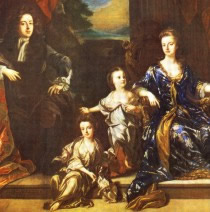
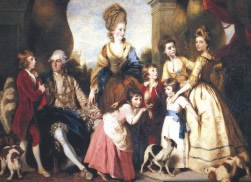
(Left) Detail from a painting by Closterman of the 1st Duke of Marlborough and his family with a small spaniel in the foreground. (Right) The family of the 4th Duke of Marlborough painted by Sir Joshua Reynolds, showing two spaniels and a whippet.
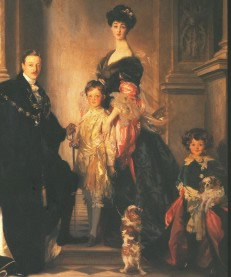
(Above) A painting by Sargent of the family of the 9th Duke of Marlborough with two spaniels.
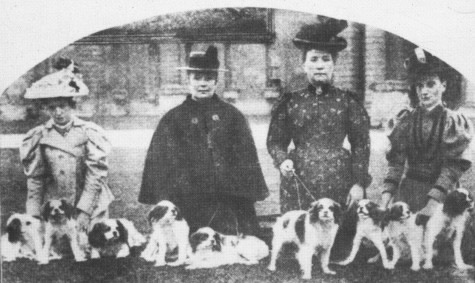
A photograph taken at Blenheim Palace in 1898 of the dogs owned by the 9th Duke of Marlborough together with their handlers.
DOG THEFT
When Judy Wright edited these pages she highlighted the growing problem of dog theft on a number of occasions. Unfortunately this is a worrying crime that seems to be spiralling at an ever-increasing pace. We therefore feel it is worthwhile mentioning it once again. There is no doubt that certain breeds are more vulnerable to theft than others. Staffordshire Bull Terriers top the list while Labradors, which are numerically the most popular dog in the UK, are way down on the list of stolen dogs. Sadly, cavaliers do feature rather high. And it is not just inner city sink estates where this crime flourishes; it is also prevalent in the well-heeled upmarket parts of town and also in villages and rural locations. It a nationwide problem that is not solely confined to any one particular area. TV star Lionel Blair and the daughter of Bruce Forsyth are two people that have had their pet dog stolen. These cases were highlighted in the media because of their celebrity status, but countless thousands of other cases occur all too frequently.
There are two excellent organizations with web sites whose aim is to try to reunite missing dogs with their owners. DogLost (www.doglost.co.uk) aims to help owners trace both lost and stolen dogs via posters, press releases and publicising details on the internet. Linda Flynn, the secretary of the Humberside CKCS Club, does an excellent job in circulating details of any missing Cavaliers on behalf of DogLost. The other organization is Dog Theft Action (www.dogtheftaction.com) who concentrate more on actual dog theft. They are an excellent lobbying group and have run seminars and stands at both Crufts and Discover Dogs. Their aim is to try to get various bodies, i.e. the police, local authorities and the veterinary profession, to work together in a more co-ordinated way. They’d like all vets to have scanners for micro chipped dogs and a central database for various authorities to work from. They are also trying to put a lot more pressure on police forces to treat the crime more seriously. Unfortunately many police forces do not investigate dog theft due to a lack of resources. Some do not even bother to give a crime number unless forced to. This then makes dog theft even more attractive to petty criminals, knowing that they will easily get away with it. Some simply set out to steal a dog just to finance their next drug fix. Dog Theft Action is actively working to raise the profile of this crime with both the police and politicians alike. To many people having their dog stolen is worse than having their house burgled and trashed. It is a crime that causes immense distressed and should be regarded as serious crime, not just a petty one.
There is no need to become paranoid, just be vigilant and adopt a few wise precautions. Make sure that your dog is well trained and will always come when called if off lead. Only let your dog off lead in areas that you feel are absolutely safe. If there are people around who appear suspicious then keep the dog on lead or use a flexi-lead. Under no circumstance ever leave a dog tethered outside a shop, even if you are only popping in for just one minute. Do not leave your dog unattended in a car; dogs taken from cars in supermarket car parks have occurred on numerous occasions. If you stop at a garage to fill up with petrol and you have your dog in the car do make sure that the car is locked before you go off to pay. Ensure that your property is well secure with no gaps in fences and front gates kept shut. In rural areas it may be a good idea to have a bell on the gate. Never leave a dog free in your garden when you are not around. Make sure that your dog has an identity tag, but avoid putting the dog’s name on it. Tattooing or micro chipping is also a recommendation.
When Judy Wright edited these pages she highlighted the growing problem of dog theft on a number of occasions. Unfortunately this is a worrying crime that seems to be spiralling at an ever-increasing pace. We therefore feel it is worthwhile mentioning it once again. There is no doubt that certain breeds are more vulnerable to theft than others. Staffordshire Bull Terriers top the list while Labradors, which are numerically the most popular dog in the UK, are way down on the list of stolen dogs. Sadly, cavaliers do feature rather high. And it is not just inner city sink estates where this crime flourishes; it is also prevalent in the well-heeled upmarket parts of town and also in villages and rural locations. It a nationwide problem that is not solely confined to any one particular area. TV star Lionel Blair and the daughter of Bruce Forsyth are two people that have had their pet dog stolen. These cases were highlighted in the media because of their celebrity status, but countless thousands of other cases occur all too frequently.
There are two excellent organizations with web sites whose aim is to try to reunite missing dogs with their owners. DogLost (www.doglost.co.uk) aims to help owners trace both lost and stolen dogs via posters, press releases and publicising details on the internet. Linda Flynn, the secretary of the Humberside CKCS Club, does an excellent job in circulating details of any missing Cavaliers on behalf of DogLost. The other organization is Dog Theft Action (www.dogtheftaction.com) who concentrate more on actual dog theft. They are an excellent lobbying group and have run seminars and stands at both Crufts and Discover Dogs. Their aim is to try to get various bodies, i.e. the police, local authorities and the veterinary profession, to work together in a more co-ordinated way. They’d like all vets to have scanners for micro chipped dogs and a central database for various authorities to work from. They are also trying to put a lot more pressure on police forces to treat the crime more seriously. Unfortunately many police forces do not investigate dog theft due to a lack of resources. Some do not even bother to give a crime number unless forced to. This then makes dog theft even more attractive to petty criminals, knowing that they will easily get away with it. Some simply set out to steal a dog just to finance their next drug fix. Dog Theft Action is actively working to raise the profile of this crime with both the police and politicians alike. To many people having their dog stolen is worse than having their house burgled and trashed. It is a crime that causes immense distressed and should be regarded as serious crime, not just a petty one.
There is no need to become paranoid, just be vigilant and adopt a few wise precautions. Make sure that your dog is well trained and will always come when called if off lead. Only let your dog off lead in areas that you feel are absolutely safe. If there are people around who appear suspicious then keep the dog on lead or use a flexi-lead. Under no circumstance ever leave a dog tethered outside a shop, even if you are only popping in for just one minute. Do not leave your dog unattended in a car; dogs taken from cars in supermarket car parks have occurred on numerous occasions. If you stop at a garage to fill up with petrol and you have your dog in the car do make sure that the car is locked before you go off to pay. Ensure that your property is well secure with no gaps in fences and front gates kept shut. In rural areas it may be a good idea to have a bell on the gate. Never leave a dog free in your garden when you are not around. Make sure that your dog has an identity tag, but avoid putting the dog’s name on it. Tattooing or micro chipping is also a recommendation.
BOOK REVIEW
The Darstardly Book for Dogs by Rex and Sparky (HarperCollins).
‘The Dangerous Book for Boys’ was published a couple of years ago, and in this age of political correctness and ‘elf-an-safety’ it appeared to be treading on rather dodgy ground. Nevertheless it became an instant best seller and probably introduced a welcome breath of fresh air into the fickle world of publishing. ‘The Darstardly Book for Dogs’ is a gentle parody of the aforementioned book but is taken from a canine viewpoint of the world. Rex and Sparky are the two dog authors who are obviously fed up with a world full of designer dog beds, jewelled collars, trendy doggy coats and organic gluten-free gourmet meals. They just want to get on and have fun tearing up pillows, sniffing other dogs’ bottoms, drinking from the lavatory bowl and generally chasing and barking at anything that moves. Chapters include: ‘Foul smells every dog should roll in’, ‘Creative pee stains’, ‘Building a bed out of your owner’s laundry’, ‘How to pick a pill out of peanut butter’ and ‘How to make your owner look like an idiot’. This last chapter includes some very poignant tips such as pooing twice when out on a walk and your owner only has one poo bag, and how to move around so fast that your owner trips up the tangled lead. I loved the doggy description of a set of traffic lights: The grey light at the top means ‘stay’, the grey light on the bottom means ‘come’, and the grey light in the middle means ‘speed up and sound your horn’. It’s a highly hilarious book that owners of all breeds, from Chihuahuas to Great Danes, are bound to identify with. The book was first published in the States and the real authors are three men and two women from New York, all of whom have a good pedigree in satirical writing in the areas of books, magazines and television. There have been a number of obvious editorial changes for this UK edition; I doubt very much if the original mentioned Chelmsford, Braintree, Caithness, Emmerdale or the Radio Times. But what does it matter, the canine world knows no national boundaries. This is a really funny volume that is bound to have any dog lover in stitches.
The Darstardly Book for Dogs by Rex and Sparky (HarperCollins).
‘The Dangerous Book for Boys’ was published a couple of years ago, and in this age of political correctness and ‘elf-an-safety’ it appeared to be treading on rather dodgy ground. Nevertheless it became an instant best seller and probably introduced a welcome breath of fresh air into the fickle world of publishing. ‘The Darstardly Book for Dogs’ is a gentle parody of the aforementioned book but is taken from a canine viewpoint of the world. Rex and Sparky are the two dog authors who are obviously fed up with a world full of designer dog beds, jewelled collars, trendy doggy coats and organic gluten-free gourmet meals. They just want to get on and have fun tearing up pillows, sniffing other dogs’ bottoms, drinking from the lavatory bowl and generally chasing and barking at anything that moves. Chapters include: ‘Foul smells every dog should roll in’, ‘Creative pee stains’, ‘Building a bed out of your owner’s laundry’, ‘How to pick a pill out of peanut butter’ and ‘How to make your owner look like an idiot’. This last chapter includes some very poignant tips such as pooing twice when out on a walk and your owner only has one poo bag, and how to move around so fast that your owner trips up the tangled lead. I loved the doggy description of a set of traffic lights: The grey light at the top means ‘stay’, the grey light on the bottom means ‘come’, and the grey light in the middle means ‘speed up and sound your horn’. It’s a highly hilarious book that owners of all breeds, from Chihuahuas to Great Danes, are bound to identify with. The book was first published in the States and the real authors are three men and two women from New York, all of whom have a good pedigree in satirical writing in the areas of books, magazines and television. There have been a number of obvious editorial changes for this UK edition; I doubt very much if the original mentioned Chelmsford, Braintree, Caithness, Emmerdale or the Radio Times. But what does it matter, the canine world knows no national boundaries. This is a really funny volume that is bound to have any dog lover in stitches.
TOP DOG ON ANIMAL PLANET
In the October pages we ran a feature on Tracey Masters and her dog Charlie. They were both selected to appear in Animal Planet’s new series of Top Dog. The shows were filmed last summer and this new season of programmes begins on Friday 14th March at 8.00pm. Tracey and Charlie will be on programme number seven which is due to be broadcast on Friday 25th April, so please do make a note of this in your diary. They are also part of the Clever Cavaliers display team and an extensive article on this group will featured in next month’s pages.
In the October pages we ran a feature on Tracey Masters and her dog Charlie. They were both selected to appear in Animal Planet’s new series of Top Dog. The shows were filmed last summer and this new season of programmes begins on Friday 14th March at 8.00pm. Tracey and Charlie will be on programme number seven which is due to be broadcast on Friday 25th April, so please do make a note of this in your diary. They are also part of the Clever Cavaliers display team and an extensive article on this group will featured in next month’s pages.
MORE CELEBRITY CAVALIER OWNERS
Thanks to everyone who e-mailed us with regard to our list of famous and infamous Cavalier owners. Here are a few more to add to the list: Emma Bunton of the Spice Girls, she owns two (Candy and Floss); Ken Doherty (Irish Snooker Champion); actresses Teri Hatcher, Clare Danes and Brittany Murphy: the husband and wife acting couple Courtney Cox and David Arquette and the veteran Hollywood star Micky Rooney. Pim Fortuyn, the controversial Dutch Politician who was assassinated in 2002 also owned two Cavaliers.
Thanks to everyone who e-mailed us with regard to our list of famous and infamous Cavalier owners. Here are a few more to add to the list: Emma Bunton of the Spice Girls, she owns two (Candy and Floss); Ken Doherty (Irish Snooker Champion); actresses Teri Hatcher, Clare Danes and Brittany Murphy: the husband and wife acting couple Courtney Cox and David Arquette and the veteran Hollywood star Micky Rooney. Pim Fortuyn, the controversial Dutch Politician who was assassinated in 2002 also owned two Cavaliers.
THOUGHT FOR THE MONTH
“The average dog has one request to all humankind – love me”
Helen Exley

If you have any questions about owning a Cavalier
then click on the envelope to email Dennis and Tina who will only be too pleased
to try and help you.
However please remember that we are not Vets or Lawyers so questions on these topics should be addressed to the professionals for advice.
Questions and answers that are of interest to other owners may be published on this page.
However please remember that we are not Vets or Lawyers so questions on these topics should be addressed to the professionals for advice.
Questions and answers that are of interest to other owners may be published on this page.
Material Copyright © 2008 The Cavalier King Charles Spaniel Club