February 2011
Edited by Tina & Dennis Homes
HAPPY FEET!
How many times have you been out for the best part of the day only to wish to be home supping a ‘nice cup of tea’ and your feet free from your shoes? I dare say many of us have felt that way at some time or other. I have to admit in my younger more fashion conscious day I thought nothing of the discomfort of wearing stilettos and winkle pickers as long as I made an impact amongst my peers at our weekly get togethers in the London clubs dancing the night away. Today, age and bunions have caught up with me and now I pay far more attention to comfort, and fashion comes way down on my list of priorities when buying shoes. So what has this to do with dogs?
Last month we wrote about grooming and tidying of feet, but perhaps we should just take an in depth look at the construction and just how our dogs use their feet.
A dog’s paws are extremely well designed. They are tough and efficient in allowing their bearer to walk anywhere. Over hard rough surfaces, grass, wet sand, snow, ice and even shiny wooden floors.
Below the wrist are five metacarpal bones, four of the pastern form the foot and the fifth one forming the dew claw on the inside of the dog’s forelegs. These are all bound together by muscle, connective tissue, nerves and blood vessels. The dog’s front feet have five pads. The large Metacarpal and four digital pads. These pads consist of subcutaneous fatty tissue which are firm cushions covered in a rough textured skin. A similar set up is found in the hind legs, though in most cavaliers the dew claw is absent.
How many times have you been out for the best part of the day only to wish to be home supping a ‘nice cup of tea’ and your feet free from your shoes? I dare say many of us have felt that way at some time or other. I have to admit in my younger more fashion conscious day I thought nothing of the discomfort of wearing stilettos and winkle pickers as long as I made an impact amongst my peers at our weekly get togethers in the London clubs dancing the night away. Today, age and bunions have caught up with me and now I pay far more attention to comfort, and fashion comes way down on my list of priorities when buying shoes. So what has this to do with dogs?
Last month we wrote about grooming and tidying of feet, but perhaps we should just take an in depth look at the construction and just how our dogs use their feet.
A dog’s paws are extremely well designed. They are tough and efficient in allowing their bearer to walk anywhere. Over hard rough surfaces, grass, wet sand, snow, ice and even shiny wooden floors.
Below the wrist are five metacarpal bones, four of the pastern form the foot and the fifth one forming the dew claw on the inside of the dog’s forelegs. These are all bound together by muscle, connective tissue, nerves and blood vessels. The dog’s front feet have five pads. The large Metacarpal and four digital pads. These pads consist of subcutaneous fatty tissue which are firm cushions covered in a rough textured skin. A similar set up is found in the hind legs, though in most cavaliers the dew claw is absent.
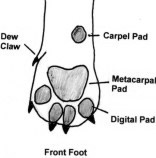
When grooming our dogs we should look daily at our dog’s feet especially after exercise. Checking the nail beds and between the pads. Making sure there are no cuts, infections or untoward growths. Some dogs can and do develop cysts in between their toes. Also do check that no grass seeds have penetrated the soft tissue between the pads, (a common cause of distress in dogs during hot dry summer months).
Small stones and grit can become lodged here, as can discarded chewing gum, and again in warmer weather, (when we get some!) molten tar deposits can also be a hazard. Whilst in icy conditions and where rock salt has been laid do make sure when you return from your walks to immerse your dog’s feet in warm water to wash out the salt. As it has been noted that this can be toxic if ingested.
Nails should be kept short and if you do try to cut these do hold the paw up to the light so that the blood vessel can clearly be seen. (Black nails are much more difficult to ascertain where the vessel is.)
Small stones and grit can become lodged here, as can discarded chewing gum, and again in warmer weather, (when we get some!) molten tar deposits can also be a hazard. Whilst in icy conditions and where rock salt has been laid do make sure when you return from your walks to immerse your dog’s feet in warm water to wash out the salt. As it has been noted that this can be toxic if ingested.
Nails should be kept short and if you do try to cut these do hold the paw up to the light so that the blood vessel can clearly be seen. (Black nails are much more difficult to ascertain where the vessel is.)

Being very careful to cut just below this line. The dew claw will also need to be cut from time to time, as these have no contact with the ground and can tend to grow very long, sometimes curling around and almost growing back into the dog’s leg. If you feel that you are unable to trim these yourself, do ask at your veterinary surgery for more professional help.
Like ourselves if we have comfortable shoes we feel good, and a comfortable dog is a happy dog.
Like ourselves if we have comfortable shoes we feel good, and a comfortable dog is a happy dog.
THE CAVALIER IN ART OVER THE CENTURIES – (Part 2) The Tricolour
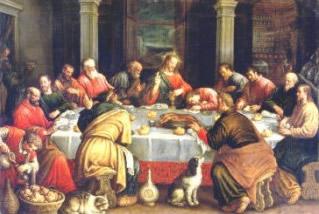
In the second part of this series we will look at a few paintings from over the centuries of tricolours. The earliest one that we’ve managed to find is from the late 1500s and painted by Bassano Leandro da Ponte. There is a small black and white spaniel featured in his painting of The Last Supper. There is absolutely no evidence to show that small toy spaniels were in Israel at the time of Jesus, but as with most Italian renaissance art, accurate visual depiction was never a priority. In fact the room setting itself with the two large pillars was probably more like an Italian room of the period than that of a room in Israel. Toy spaniels were believed to have originated in China and the Far East and brought to Italy by merchants and traders and there were probably quite a lot in Italy in the 1500s. Below is the painting plus a detail of the spaniel.
In the second part of this series we will look at a few paintings from over the centuries of tricolours. The earliest one that we’ve managed to find is from the late 1500s and painted by Bassano Leandro da Ponte. There is a small black and white spaniel featured in his painting of The Last Supper. There is absolutely no evidence to show that small toy spaniels were in Israel at the time of Jesus, but as with most Italian renaissance art, accurate visual depiction was never a priority. In fact the room setting itself with the two large pillars was probably more like an Italian room of the period than that of a room in Israel. Toy spaniels were believed to have originated in China and the Far East and brought to Italy by merchants and traders and there were probably quite a lot in Italy in the 1500s. Below is the painting plus a detail of the spaniel.

Below are two paintings of tricolours, both from the late 17th century.
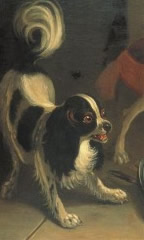
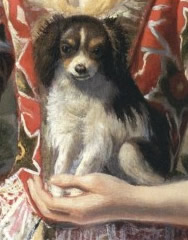
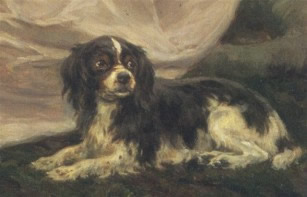
The follow three paintings are from the second half of the 19th century. The first was painted in 1853, the second in 1864 and the third, which is not too dissimilar to a Cavalier of today, was painted in 1885.


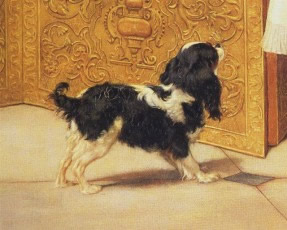
Below we have a painting of a tricolour from 1910. Many books state that around that time the longer nosed “Cavalier” type was almost extinct and that the short faced “King Charles Spaniels” was prevalent. This painting shows that you could still find some longer nosed toy spaniels.
DOG TOYS
Many of you may have seen an item by Norma Inglis in her Chatterbox page on 24th December on www.cavaliers.co.uk where she told of the case of a Cavalier that ate a child’s teddy bear and became very ill. When the vet opened up the dog to remove what was thought to be an obstruction she found a huge gelatine type mess and the dog’s intestines were black and the tissue dead. Sadly the dog died. They later discovered that the stuffing in the toy contained ingredients for flame retardants and mite control! It is designed to become a gel and is highly toxic.Toys are important to dogs. They prevent them from becoming bored when left alone and can stop behavioural problems, such as destructive chewing or digging. Most dogs will play with just about anything they can get their paws on, regardless of injury to themselves, so you must be very careful in deciding what items to allow for play, particularly if the play is to be unsupervised.
Firstly, any toy should be appropriate for your dog’s size and strength. There are big dogs who are very gentle and small terriers that will “kill” and tear any toy apart, so it is best to watch how your own dog uses his toys to get an idea of how he interacts with them. For example, some dogs will treasure a soft toy for the rest of its life, carrying it around like a baby, whilst others will pull the stuffing out in ten seconds flat. This often has nothing to do with the breed but rather with the individual personality of the dog.
Generally speaking, any toy with small, detachable parts (such as glass eyes) is unsafe. You can make them safer by removing ribbons, strings, eyes, or other parts that could be chewed or ingested but if you are unsure, it is best to avoid. Even soft toys without small parts can be dangerous if your dog likes to rip and tear as he could ingest the stuffing which might be toxic or cause intestinal blockages.
Another potentially dangerous toy is rawhide chews. These are pieces of cow skin which have been chemically treated, stretched and then dried into a variety of shapes (i.e. knots, sticks, rings). Not only can the rawhide break off into small chunks which can scratch or puncture your dog’s gastrointestinal tract, it can also be a severe choking hazard once it is thoroughly wet, as it becomes a thick, sticky mass that could get stuck in your dog’s throat.
Pig’s ears and trotters can also be dangerous: the pressure from chewing often breaks the fourth premolar tooth. Bacteria then work their way up the fractured tooth into the root, resulting in abscess.
Most household items do not make good toys. These include things like socks, shoes, treated wood, cardboard boxes, plastic bottles, etc. Not only does this teach dogs bad habits and the wrong things to chew, some of these materials contain toxic chemicals; others can be easily shredded and swallowed, causing intestinal blockages. Wood and plastic can become lodged in gum tissue, causing painful injuries and infections.
Sticks and twigs can very dangerous – they can easily snap and sharp ends or splinters embed themselves into your dog’s mouth. They can also bounce back when thrown and impale a dog that is running to catch it. Do not play fetch with sticks – use a properly designed rubber dog toy instead.
SAFE TOYS
Providing that they are the right size and material, balls make great toys for dogs and most canines love a game of fetch. Nowadays, pet stores stock a variety of rubber balls, tennis balls and even footballs specially designed for your canine friend.
Kongs are a good dog toy – these are hard rubber chew toys in a variety of shapes, all with a hollow centre which can be stuffed with treats. They keep a dog entertained for hours and have been made to withstand even the toughest chewers. They now come in a range of types. Nylabones are also but keep a check that they do not become too worn and they are best given to a dog while under supervision.
Puzzle toys such as treat balls, are another wonderful source of entertainment for your dog. You fill the hollow centre with dry treats (e.g. dog biscuits) and then your dog has to roll the toy around, with treats falling out at random from strategically placed holes. They can keep a dog occupied for long periods of time alone.
Cotton rope toys, usually twisted and knotted at both ends to make a bone shape, are also popular and generally safe although a poorly–made rope toy may not withstand constant tugging and pulling and your dog may swallow a string or two. So it is best that they are used under supervision. As with all toys, always regularly check for wear and tear and replace when necessary.
DOGGY BREAKFAST TIME
Not a Cavalier, but a You Tube video clip that we are sure all dog owners will love!
http://www.youtube.com/watch?v=HaAVZ2yXDBo&NR=1&feature=fvwp
Not a Cavalier, but a You Tube video clip that we are sure all dog owners will love!
http://www.youtube.com/watch?v=HaAVZ2yXDBo&NR=1&feature=fvwp
A NEW GROOMING TOOL
We received an email from Roy Gadsby of Carlisle about a new grooming tool that Dyson have recently launched. This is what he says:
“I purchased the new tool costing £40 direct from Dyson in the autumn. It is only presently available online from Dyson. Dyson website gives data on which Dyson Vacuums the attachment fits.
The Dyson Groomer fits on the vacuum hose and with the wire scarifier brushing actions can be undertaken. A click of a button on the attachment sucks built–up dead hair removed from the dog’s coat. Instructions come with the attachment with obvious delicate areas not to groom and not when wet!
Our Cavaliers get their regular groom and the carpet and upholstery are cleaned. The lounge carpet has just been Bissell washed and the two dogs, (a Ruby and a Black & Tan), have silky coats that shine so nice ready to be taken for daily walks.
The tool I believe is going to be available in shops from springtime. I’ve now found the robust groomer is also handy, (along with turbo brush), for extracting/loosening stubborn embedded silky dog hair that is difficult to remove from pet fleece and carpets by simply adjusting the comb length on the attachment.”
A link to the Dyson site is:
http://www.dyson.co.uk/vacuums/groom/howWorks.asp?dgt_InstructType=groomComic
We received an email from Roy Gadsby of Carlisle about a new grooming tool that Dyson have recently launched. This is what he says:
“I purchased the new tool costing £40 direct from Dyson in the autumn. It is only presently available online from Dyson. Dyson website gives data on which Dyson Vacuums the attachment fits.
The Dyson Groomer fits on the vacuum hose and with the wire scarifier brushing actions can be undertaken. A click of a button on the attachment sucks built–up dead hair removed from the dog’s coat. Instructions come with the attachment with obvious delicate areas not to groom and not when wet!
Our Cavaliers get their regular groom and the carpet and upholstery are cleaned. The lounge carpet has just been Bissell washed and the two dogs, (a Ruby and a Black & Tan), have silky coats that shine so nice ready to be taken for daily walks.
The tool I believe is going to be available in shops from springtime. I’ve now found the robust groomer is also handy, (along with turbo brush), for extracting/loosening stubborn embedded silky dog hair that is difficult to remove from pet fleece and carpets by simply adjusting the comb length on the attachment.”
A link to the Dyson site is:
http://www.dyson.co.uk/vacuums/groom/howWorks.asp?dgt_InstructType=groomComic
IF
If you can start the day without caffeine,
If you can get going without pep pills,
If you can always be cheerful, ignoring aches and pains,
If you can resist complaining and boring people with your troubles,
If you can eat the same food everyday and be grateful for it,
If you can understand when your loved ones are too busy to give you any time.
If you can overlook it when those you love take it out on you,
If you can take criticism and blame without resentment,
If you can ignore a friend’s limited education and never correct him,
If you can resist treating a rich friend better than an poor friend,
If you can face the world without lies and deceit,
If you can conquer tension without medical help,
If you can relax without liquor,
If you can sleep without the aid of drugs,
If you can say honestly that deep in your heart you have no prejudice against creed, colour, religion or politics,
THEN, my friend, you are almost as good as your dog.
If you can start the day without caffeine,
If you can get going without pep pills,
If you can always be cheerful, ignoring aches and pains,
If you can resist complaining and boring people with your troubles,
If you can eat the same food everyday and be grateful for it,
If you can understand when your loved ones are too busy to give you any time.
If you can overlook it when those you love take it out on you,
If you can take criticism and blame without resentment,
If you can ignore a friend’s limited education and never correct him,
If you can resist treating a rich friend better than an poor friend,
If you can face the world without lies and deceit,
If you can conquer tension without medical help,
If you can relax without liquor,
If you can sleep without the aid of drugs,
If you can say honestly that deep in your heart you have no prejudice against creed, colour, religion or politics,
THEN, my friend, you are almost as good as your dog.
Author Unknown
NEWS IN BRIEF
According to a report in the China Daily Beijing is considering the implementation of a one–dog policy. Under the proposed legislation each household will be allowed to own just one dog. If a dog has puppies they must be given away to eligible homes or government approved adoption agencies before they are three months old.
******
In Japan a long coated Chihuahua has passed an exam to become a police dog. Named Momo, he passed a search and rescue test by finding a person in less than 5 minutes by sniffing their cap. He will be used in rescue operations in disasters such as earthquakes where time is of the utmost importance in locating people.
******
Zippo is a black and white Boston Terrier who was born profoundly deaf. Now at the age of two he has passed the Kennel Club’s toughest obedience test with flying colours simply by learning to respond to a system of sign language that his owner Vicky Tate has devised using arm and leg signals. A Kennel Club spokeswoman said that passing this high level test is a great achievement for any dog, but for one that has a disability such as deafness it is amazing.
******
McCoy is a nine year old dog owned by Cara Watts from Nuneaton. He decided to relieve himself by lifting his leg against a lamp post when he received a rather nasty shock. Apparently vandals had removed the protective metal plate from the lamp post leaving exposed wires. The electric current travelled along the dog’s stream and left him howling. Fortunately he had no lasting effects and was soon back to his normal self.
******
The old saying “You can’t teach old dogs new tricks” may be partly true. Researchers recently carried out tests on fifty dogs where they were required to make a detour through a visible gap in a barrier to receive a treat from their owner. Most dogs found this quite easy with 80% getting it right first time. The task was repeated several times. The gap was then shifted to the other end but still visible, however the majority of the dogs (46 out of 50) failed to find the gap and went on the first learned route. The lesson to be learned when training a dog is that habits can very quickly become ingrained.
According to a report in the China Daily Beijing is considering the implementation of a one–dog policy. Under the proposed legislation each household will be allowed to own just one dog. If a dog has puppies they must be given away to eligible homes or government approved adoption agencies before they are three months old.
******
In Japan a long coated Chihuahua has passed an exam to become a police dog. Named Momo, he passed a search and rescue test by finding a person in less than 5 minutes by sniffing their cap. He will be used in rescue operations in disasters such as earthquakes where time is of the utmost importance in locating people.
******
Zippo is a black and white Boston Terrier who was born profoundly deaf. Now at the age of two he has passed the Kennel Club’s toughest obedience test with flying colours simply by learning to respond to a system of sign language that his owner Vicky Tate has devised using arm and leg signals. A Kennel Club spokeswoman said that passing this high level test is a great achievement for any dog, but for one that has a disability such as deafness it is amazing.
******
McCoy is a nine year old dog owned by Cara Watts from Nuneaton. He decided to relieve himself by lifting his leg against a lamp post when he received a rather nasty shock. Apparently vandals had removed the protective metal plate from the lamp post leaving exposed wires. The electric current travelled along the dog’s stream and left him howling. Fortunately he had no lasting effects and was soon back to his normal self.
******
The old saying “You can’t teach old dogs new tricks” may be partly true. Researchers recently carried out tests on fifty dogs where they were required to make a detour through a visible gap in a barrier to receive a treat from their owner. Most dogs found this quite easy with 80% getting it right first time. The task was repeated several times. The gap was then shifted to the other end but still visible, however the majority of the dogs (46 out of 50) failed to find the gap and went on the first learned route. The lesson to be learned when training a dog is that habits can very quickly become ingrained.
PHOTO OF THE MONTH
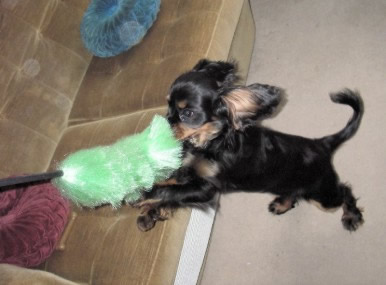
This month’s photo is of Herbie the Hobgoblin! He is owned by Rosemary Powell who runs Cavalier Helping Hearts which has, over the years, raised quite a lot of money for heart research in Cavaliers.
“To err is human, to forgive is canine.”
If you have any questions about owning a Cavalier then click on the envelope to email Dennis and Tina who will only be too pleased to try and help you.
However please remember that we are not Vets or Lawyers so questions on these topics should be addressed to the professionals for advice.
Questions and answers that are of interest to other owners may be published on this page.
The Cavalier Club is not responsible for external website content.
However please remember that we are not Vets or Lawyers so questions on these topics should be addressed to the professionals for advice.
Questions and answers that are of interest to other owners may be published on this page.
The Cavalier Club is not responsible for external website content.
Material Copyright © 2011 The Cavalier King Charles Spaniel Club