Cavaliers as Companions
November 2011
Edited by Tina & Dennis Homes
THE CAVALIER’S PETS
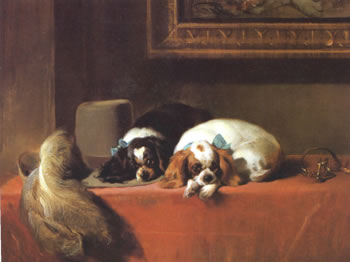
Above is the famous painting by Sir Edwin Landseer entitled "The Cavalier’s Pets." This iconic painting is probably the best known within the Cavalier world. After Roswell Eldridge offered a prize of £25 at Crufts for the best examples of the ‘spaniels of the old type as shown in the pictures of Charles II time’, the Crufts’ catalogues of the next five years included copies of this painting above the class entries for these special classes. On the second day of Crufts in 1928 a small group of enthusiasts got together and formed The Cavalier King Charles Spaniel Club and when drawing up the standard for the breed the famous dog Ann’s Son was brought along as he was regarded as a highly desired example of the breed. A copy of this painting was also displayed as these dogs represented the type of spaniel that they were trying to revive. To differentiate this revived breed from the shorter faced King Charles Spaniel the name Cavalier was added and was taken from the title of this painting. Since then the painting has been feature in countless books about Cavaliers and on postcards, greetings cards and also on many other types of Cavalier memorabilia. It has also been a much copied painting and below are just five examples of copies painted by other artists. At first glance they may all appear to be the same, but when you look closely you can easily since the differences.


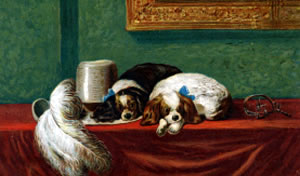

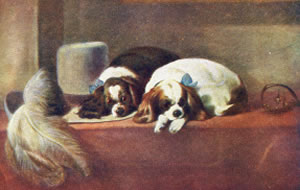
Other artists have also used these dogs in various works of their own and below are three examples.


We wrote a short feature about this painting back in July 2007 in which we showed a couple of our own dogs in this pose together with our interpretation of the painting. To view click here.
DEWCLAWS
Dewclaws are rudimentary thumbs and rear dewclaws are residual fixtures from the past. They have no function and are situated high on the inside of the leg above the foot. In most breeds they do not make contact with the ground but are said to brush the dew from the grass and it is thought that this is where they get their name. Although dogs have dewclaws on the inside of the front legs they do occasionally have them on the hind legs. Hind dewclaws are quite rare in Cavaliers. Unlike front dewclaws, rear dewclaws tend to have little bone or muscle structure in most breeds. Occasionally a dog may even have more than one dewclaw on the same foot and this is known as being double dewclawed. Usually one of these dewclaws will be poorly connected to the leg and may have to be surgically removed. In some dog breeds the dewclaw makes contact when they are running and the nail on the dewclaw often wears down in the same way that the nails on their other toes do, from contact with the ground. However, with most dogs the dewclaws never make contact with the ground and therefore the dewclaws nail never wears down and needs to be trimmed to keep it to a safe length.
With wolves and wild dogs the dewclaws are used to help rip open the flesh of animals brought down as prey, but with the domesticated dog it is highly debatable as to whether they are needed. They are not dead appendages, they can be used to lightly grip bones and other items that dogs hold with the paws. However, in some dogs these claws may not appear to be connected to the leg at all except by a flap of skin; in such dogs the claws do not have a use for gripping as the claw can easily fold or turn.
There has been a strong debate as to whether dewclaws should be surgically removed. It can be argued that dewclaws are a weak digit that can easy rip apart or easily catch on something and break, becoming extremely painful and prone to infection. Although the removal of dewclaws is permitted in the UK, it is illegal in some other countries. As with tail docking, an exception is made for hunting dogs who can sometimes tear the dewclaw while running in overgrown vegetation. If a dewclaw is to be removed, this should be done when the dog is a very young puppy, maybe as young as 3 days old.
As they do not wear down naturally through walking you should regularly check them and make sure that they do not grow too long. On short coated breeds they be seen quite clearly, but on breeds such as the Cavalier where there is a lot of coat feathering on the legs they are virtually invisible and many pet owners forget that their dog has them. We have encountered quite a number of pet Cavaliers that have had dewclaws grow so long that they have turned full circle and started to pierce the skin which is very painful for the poor dog. So please do check your dog’s dewclaws on a regular basis and trim the nails when necessary.
Dewclaws are rudimentary thumbs and rear dewclaws are residual fixtures from the past. They have no function and are situated high on the inside of the leg above the foot. In most breeds they do not make contact with the ground but are said to brush the dew from the grass and it is thought that this is where they get their name. Although dogs have dewclaws on the inside of the front legs they do occasionally have them on the hind legs. Hind dewclaws are quite rare in Cavaliers. Unlike front dewclaws, rear dewclaws tend to have little bone or muscle structure in most breeds. Occasionally a dog may even have more than one dewclaw on the same foot and this is known as being double dewclawed. Usually one of these dewclaws will be poorly connected to the leg and may have to be surgically removed. In some dog breeds the dewclaw makes contact when they are running and the nail on the dewclaw often wears down in the same way that the nails on their other toes do, from contact with the ground. However, with most dogs the dewclaws never make contact with the ground and therefore the dewclaws nail never wears down and needs to be trimmed to keep it to a safe length.
With wolves and wild dogs the dewclaws are used to help rip open the flesh of animals brought down as prey, but with the domesticated dog it is highly debatable as to whether they are needed. They are not dead appendages, they can be used to lightly grip bones and other items that dogs hold with the paws. However, in some dogs these claws may not appear to be connected to the leg at all except by a flap of skin; in such dogs the claws do not have a use for gripping as the claw can easily fold or turn.
There has been a strong debate as to whether dewclaws should be surgically removed. It can be argued that dewclaws are a weak digit that can easy rip apart or easily catch on something and break, becoming extremely painful and prone to infection. Although the removal of dewclaws is permitted in the UK, it is illegal in some other countries. As with tail docking, an exception is made for hunting dogs who can sometimes tear the dewclaw while running in overgrown vegetation. If a dewclaw is to be removed, this should be done when the dog is a very young puppy, maybe as young as 3 days old.
As they do not wear down naturally through walking you should regularly check them and make sure that they do not grow too long. On short coated breeds they be seen quite clearly, but on breeds such as the Cavalier where there is a lot of coat feathering on the legs they are virtually invisible and many pet owners forget that their dog has them. We have encountered quite a number of pet Cavaliers that have had dewclaws grow so long that they have turned full circle and started to pierce the skin which is very painful for the poor dog. So please do check your dog’s dewclaws on a regular basis and trim the nails when necessary.
HEARING
Dogs hear at a wider range of frequencies than humans. The low end of the range is similar, but dogs hear sounds up to 45 kHz, while humans only hear sounds up to about 23 kHz. This means that they could be hearing and responding to sounds that we can’t hear at all. Cats can hear sounds as high as 64 kHz, bats up to 110 kHz and porpoises up to 150 kHz! Younger people and animals generally have more acute hearing than older ones.
At the higher and lower ends of audible frequencies the sounds must be louder or more intense in decibels for us to hear them. A dog can therefore hear an alarm bell further away than we could. Pain results from sounds that are much louder than our threshold of hearing. Dogs can feel pain from sounds that are not painfully loud to us. Very loud sounds can hurt our ears and if a sound seems too loud to us, it is probably even more so to your dog.
The hearing ability of a dog is dependent on its breed and age. However, the range of hearing is approximately 40 Hz to 60,000 Hz, which is much greater than that of humans. When dogs hear a sound, they will move their ears towards it in order to maximize reception. In order to achieve this, the ears of a dog are controlled by at least 18 muscles. This allows the ears to tilt and rotate. Ear shape also allows for the sound to be more accurately heard. Many breeds often have upright and curved ears, which direct and amplify the sounds. As dogs hear much higher frequency sounds than humans, they have a different perception of the world. Sounds that seem loud to humans often emit high frequency tones that can scare away dogs. Ultrasonic signals are used in training whistles, as a dog will respond much better to such levels. In the wild, dogs use their hearing capabilities to hunt and locate food. Certain breeds are used as guard dogs due to their increased hearing ability.
Dogs hear at a wider range of frequencies than humans. The low end of the range is similar, but dogs hear sounds up to 45 kHz, while humans only hear sounds up to about 23 kHz. This means that they could be hearing and responding to sounds that we can’t hear at all. Cats can hear sounds as high as 64 kHz, bats up to 110 kHz and porpoises up to 150 kHz! Younger people and animals generally have more acute hearing than older ones.
At the higher and lower ends of audible frequencies the sounds must be louder or more intense in decibels for us to hear them. A dog can therefore hear an alarm bell further away than we could. Pain results from sounds that are much louder than our threshold of hearing. Dogs can feel pain from sounds that are not painfully loud to us. Very loud sounds can hurt our ears and if a sound seems too loud to us, it is probably even more so to your dog.
The hearing ability of a dog is dependent on its breed and age. However, the range of hearing is approximately 40 Hz to 60,000 Hz, which is much greater than that of humans. When dogs hear a sound, they will move their ears towards it in order to maximize reception. In order to achieve this, the ears of a dog are controlled by at least 18 muscles. This allows the ears to tilt and rotate. Ear shape also allows for the sound to be more accurately heard. Many breeds often have upright and curved ears, which direct and amplify the sounds. As dogs hear much higher frequency sounds than humans, they have a different perception of the world. Sounds that seem loud to humans often emit high frequency tones that can scare away dogs. Ultrasonic signals are used in training whistles, as a dog will respond much better to such levels. In the wild, dogs use their hearing capabilities to hunt and locate food. Certain breeds are used as guard dogs due to their increased hearing ability.
REVERSE SNEEZING
Pharyngeal Gag Reflex, more commonly known as Reverse Sneezing, is a rapid inhalation of air through the nose which causes the dog to make repetitive snorting sounds almost as if he is choking. This is also sometimes referred to as Inspiratory Paroxysmal Respiration. Often when a pet owner first encounters their dog doing this is causes great alarm but in the majority of cases there is absolutely nothing to worry about. A reverse sneeze can last from just a few seconds or up to a minute or so. Smaller breeds are more prone to this condition especially breeds with shorter muzzles whereby they often have an overlong soft palate which is the soft fleshy extension of the hard palate at the roof of the mouth. It will sometimes be sucked across the entrance to the larynx and this in turn will make the dog snort. Various things may cause an incident to start, most commonly pulling on a lead when out walking. Foreign bodies and even pollens in the nasal passage may cause a reaction. The best way to stop the dog from snorting is to hold him still and briefly close his nostrils until he swallows or gently rub his throat. Usually the dog is quickly back to normal. It is only in cases where a dog has an excessively overlong soft palate that veterinary treatment is needed and fortunately that is not a common ailment in Cavaliers. Dogs who are afflicted by this usually pant and snort quite a lot of the time.
Pharyngeal Gag Reflex, more commonly known as Reverse Sneezing, is a rapid inhalation of air through the nose which causes the dog to make repetitive snorting sounds almost as if he is choking. This is also sometimes referred to as Inspiratory Paroxysmal Respiration. Often when a pet owner first encounters their dog doing this is causes great alarm but in the majority of cases there is absolutely nothing to worry about. A reverse sneeze can last from just a few seconds or up to a minute or so. Smaller breeds are more prone to this condition especially breeds with shorter muzzles whereby they often have an overlong soft palate which is the soft fleshy extension of the hard palate at the roof of the mouth. It will sometimes be sucked across the entrance to the larynx and this in turn will make the dog snort. Various things may cause an incident to start, most commonly pulling on a lead when out walking. Foreign bodies and even pollens in the nasal passage may cause a reaction. The best way to stop the dog from snorting is to hold him still and briefly close his nostrils until he swallows or gently rub his throat. Usually the dog is quickly back to normal. It is only in cases where a dog has an excessively overlong soft palate that veterinary treatment is needed and fortunately that is not a common ailment in Cavaliers. Dogs who are afflicted by this usually pant and snort quite a lot of the time.
CAVALIER CHRISTMAS CARDS
Last month we mentioned the Foetal Tissue Research Online Shop that was selling some wonderful cards and calendars to raise funds for the FTR project. Some super Cavalier Christmas cards are now available for sale which can be seen at www.ftrproject.com Well worth a visit.
Last month we mentioned the Foetal Tissue Research Online Shop that was selling some wonderful cards and calendars to raise funds for the FTR project. Some super Cavalier Christmas cards are now available for sale which can be seen at www.ftrproject.com Well worth a visit.
PHOTO OF THE MONTH
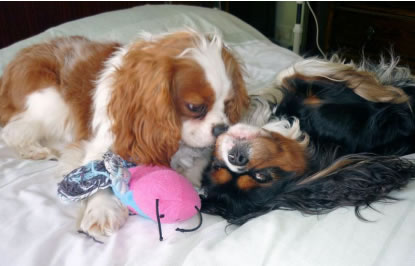
Above are Sidney the Blenheim and his best friend Bertie the Tricolour in a typical Cavalier pose. Both are owned and much loved by Julie Carmichael from Murton, Co. Durham whom we thank for this very cute photo.
* * * * * * * * * *
Don’t forget to check out Wags and Wiggles online pages with lots of interesting article for Cavalier pet owners. They can be found at: www.grandvillecavaliers.com/wagsandwiggles/indexww.html
Above are Sidney the Blenheim and his best friend Bertie the Tricolour in a typical Cavalier pose. Both are owned and much loved by Julie Carmichael from Murton, Co. Durham whom we thank for this very cute photo.
* * * * * * * * * *
THOUGHT FOR THE MONTH
"The great pleasure of a dog is that you may make a fool of yourself with him and not only will he not scold you, but he will make a fool of himself too."
Samuel Butler
"The great pleasure of a dog is that you may make a fool of yourself with him and not only will he not scold you, but he will make a fool of himself too."
Samuel Butler
If you have any questions about owning a Cavalier then click on the envelope to email Dennis and Tina who will only be too pleased to try and help you.
However please remember that we are not Vets or Lawyers so questions on these topics should be addressed to the professionals for advice.
Questions and answers that are of interest to other owners may be published on this page.
The Cavalier Club is not responsible for external website content.
However please remember that we are not Vets or Lawyers so questions on these topics should be addressed to the professionals for advice.
Questions and answers that are of interest to other owners may be published on this page.
The Cavalier Club is not responsible for external website content.
Material Copyright © 2011 The Cavalier King Charles Spaniel Club